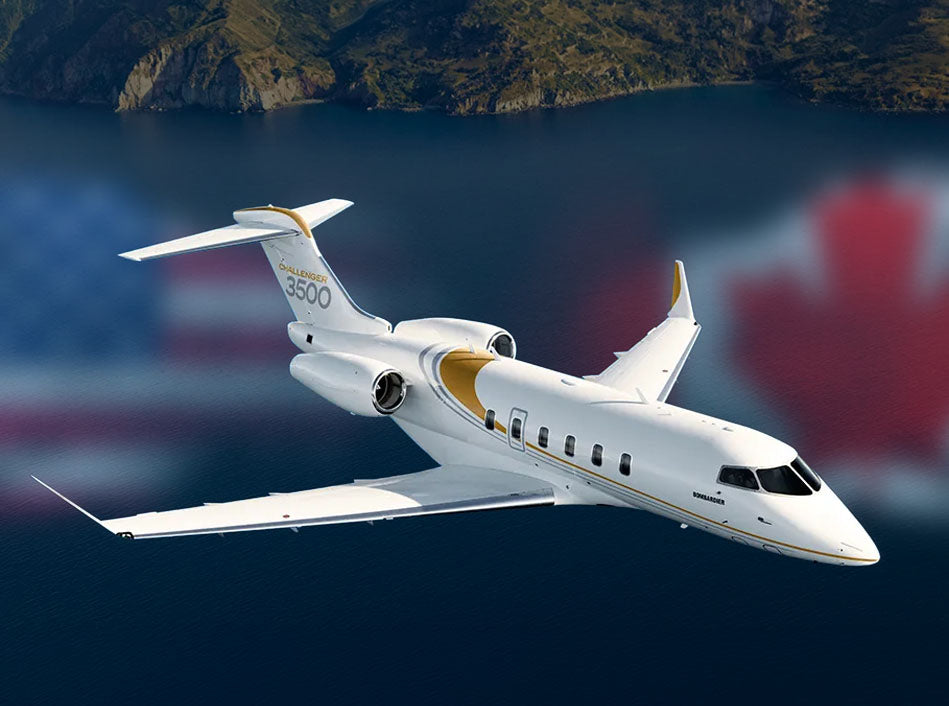
In the wake of Donald Trump’s latest broadside against Bombardier, the industry’s attention is settling on a more practical risk than the headline-grabbing threat of “decertifying” Canadian-built business jets: tariffs.
At Corporate Jet Investor in London, panelists and legal experts argued that outright decertification of in-service aircraft is highly improbable—so improbable, in fact, that it’s largely a distraction from the policy lever that could bite faster and with fewer procedural hurdles. In their view, tariffs—while still far from certain—sit in the murkier zone where political pressure, trade signaling, and executive posture can create real commercial friction even without grounding airplanes.
That distinction matters because Bombardier equipment is deeply embedded in the U.S. private aviation ecosystem. A significant share of the largest U.S. fractional and charter operators rely on Challengers and Globals as core fleet types. Any shift in cross-border economics—especially one as blunt as a large import duty—would ripple through acquisition decisions, delivery schedules, and potentially even maintenance costs if parts and supply chains are swept into the same trade logic.
What Trump threatened—and why decertification is a long shot
The catalyst was a social media post in which Donald Trump criticized Transport Canada for not validating certification of several Gulfstream Aerospace models—then floated retaliation that included “decertifying” Canadian-made aircraft in U.S. operation, alongside the prospect of a steep tariff on Canadian aircraft sold into the United States.
Industry lawyers speaking in London emphasized that “decertification,” as framed rhetorically, doesn’t map cleanly onto how aircraft approval and continued airworthiness actually work. One aviation attorney noted that pulling operating authority for existing aircraft would typically require a genuine safety predicate—something evidenced, documented, and procedurally defensible. Absent that, the threat reads less like a near-term operational scenario and more like negotiating pressure designed to draw a reaction.
Another panelist largely agreed, while adding a familiar caveat: with Donald Trump, unconventional tactics and edge-case arguments are never fully off the table. Even so, they suggested any attempt to assert sweeping authority over in-service aircraft on non-safety grounds would be met immediately with legal challenges—and would face a steep climb through the courts.
The real exposure: tariffs and commercial knock-on effects
Where the discussion turned more sober was tariffs. Unlike decertification, a tariff doesn’t need to prove an airworthiness issue to create pain. It can simply change the economics of new deliveries overnight—nudging buyers to pause, reshuffle fleet plans, or renegotiate terms. And even the threat of a tariff can create delay, as buyers and sellers struggle to price risk into transactions.
Panelists also warned that tariffs can boomerang. Aerospace supply chains run both ways across the U.S.–Canada corridor, and business jets are rarely “made” in one place in the way the political soundbite implies. Components, subassemblies, and specialized systems often trace back to U.S. suppliers—even on aircraft with Canadian final assembly. A broad measure intended to punish one manufacturer could, in practice, tax U.S. jobs, U.S. vendors, and U.S. export strength.
That point was underscored with trade figures meant to reframe the debate: aviation and aerospace exports, the panel noted, are typically a net win for the United States—one reason policymakers tend to tread carefully before destabilizing the sector. Beyond macro statistics, speakers highlighted Bombardier’s U.S. footprint: thousands of employees and a large supplier base spread across American states.
Who’s flying Bombardier in the U.S. today
The reason this episode is being watched so closely is simple: it’s not theoretical. Bombardier models underpin product offerings across major programs, including:
-
NetJets, with Globals and Challengers featured across multiple tiers
-
Flexjet, with Challenger variants as marquee aircraft
-
Airshare, offering Challenger aircraft in its lineup
-
flyExclusive, including a pre-owned Challenger fractional program
-
VistaJet, utilizing Globals and Challengers in membership operations
-
Wheels Up, expanding Challenger presence within charter activity
-
Nicholas Air, featuring Challenger aircraft in jet card programs
Separately, speakers pointed to the practical exposure on the horizon: new aircraft orders and scheduled deliveries. Any tariff regime aimed at new aircraft imports would be felt immediately in forward order books—especially for entrants planning to scale fleets on predictable delivery timelines.
The “Switzerland lesson,” and why uncertainty is the problem
The panel referenced prior trade actions as a cautionary precedent: when import duties land, even temporarily, the industry is forced into contingency planning—sometimes at significant cost. The larger issue is uncertainty. Operators, lessors, and buyers can price known costs; they struggle when the rules may change mid-transaction.
Even if tariffs were ultimately negotiated down or delayed, the interim could still slow decisions, complicate closings, and make lenders and insurers more conservative on cross-border exposure.
What operators and buyers can do now
The panel’s practical guidance was less about politics and more about contract hygiene:
-
Strengthen force majeure language so that tariffs are explicitly covered (not implied).
-
Stress-test maintenance assumptions if parts costs or cross-border logistics could be affected.
-
Model delivery and acceptance scenarios that include tariff triggers, timing risk, and renegotiation provisions.
In short: decertification makes headlines, but tariffs move spreadsheets. And in an industry where timing, predictability, and contract certainty are everything, even a credible possibility of new duties can shape behavior long before any formal policy lands.